Spores
Authors, stage directors and set designers: Pakui Hardware (Neringa Černiauskaitė and Ugnius Gelguda)
Text authors: Pakui Hardware and artificial intelligence therapist
Composer: Miša Skalskis
Producers: Operomanija, Performa
Date and time: September 25th 6:00 p.m. and 8:00 p.m., September 26th 6:00 p.m. and 8:00 p.m.
Venue: Vilnius University, Aula Parva Hall (Universiteto st. 3, Vilnius)
Duration: 60 minutes
Age recommendation: N-10

This musical performance was created for the Vilnius Contemporary Opera Festival NOA and the Lithuanian Pavilion Without Walls programme at the performance biennial Performa in New York.
Mushroom picking with a therapist
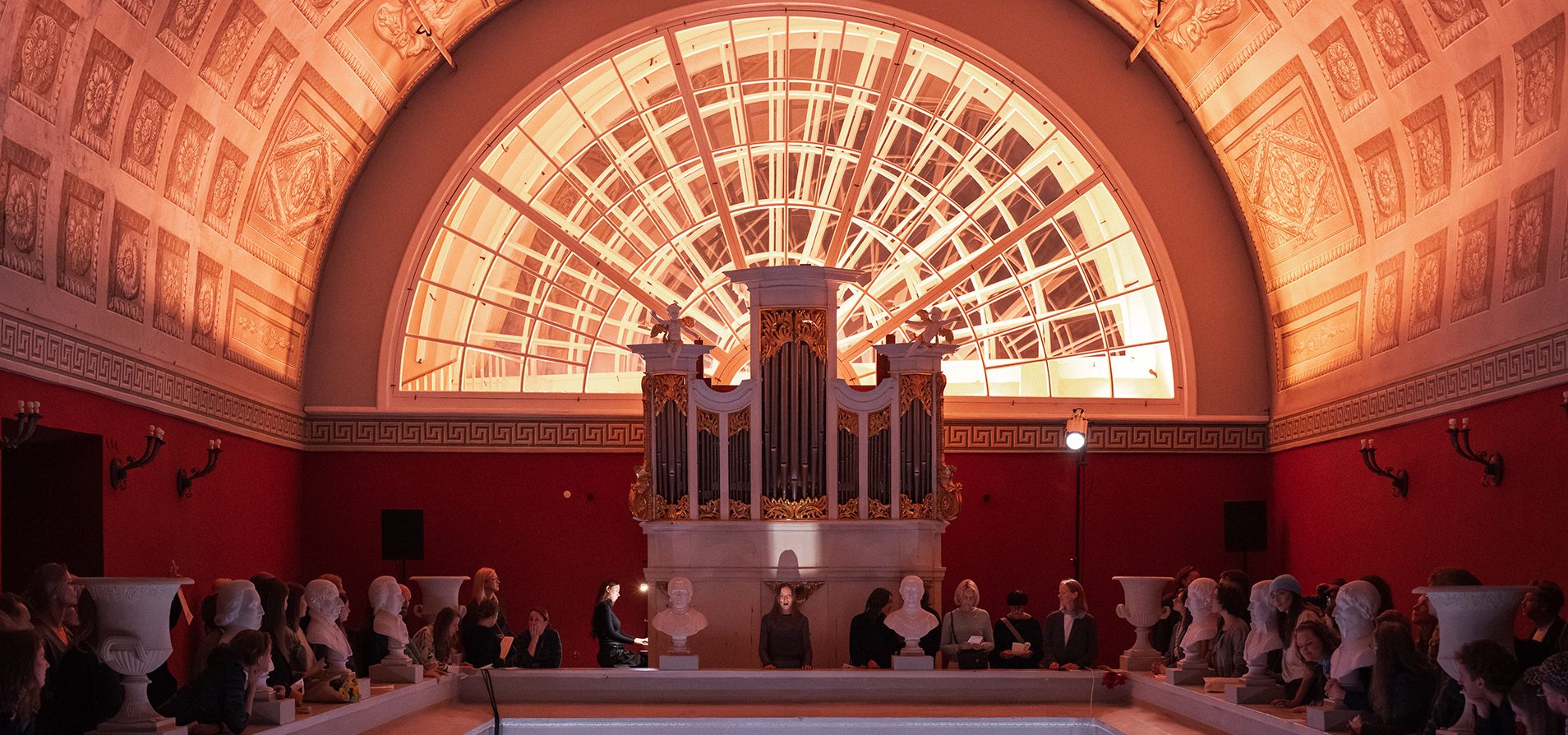
The musical performance Spores explores the intertwining of emotional health and technology, live and virtual assistance in today’s world. The protagonist of the piece is one of many people in the modern world who tries to express her anxiety to a therapist amid a flood of information and emotional stimuli. However, this therapist is virtual, an advisor imbued with the wisdom of artificial intelligence. Their conversations, based on Western therapeutic theories, help them navigate the turbulent waters of everyday worries and grievances. However, by unconditionally supporting the patient, this advisor encourages attachment and creates an artificially positive environment – like a mirror reflecting the desires and emotions expressed to it. Are these virtual psychotherapists Ariadne’s thread, helping to find a way out of the labyrinth of dark thoughts and emotions, or does this thread only further confuse and weave the knots of dependence on technology?
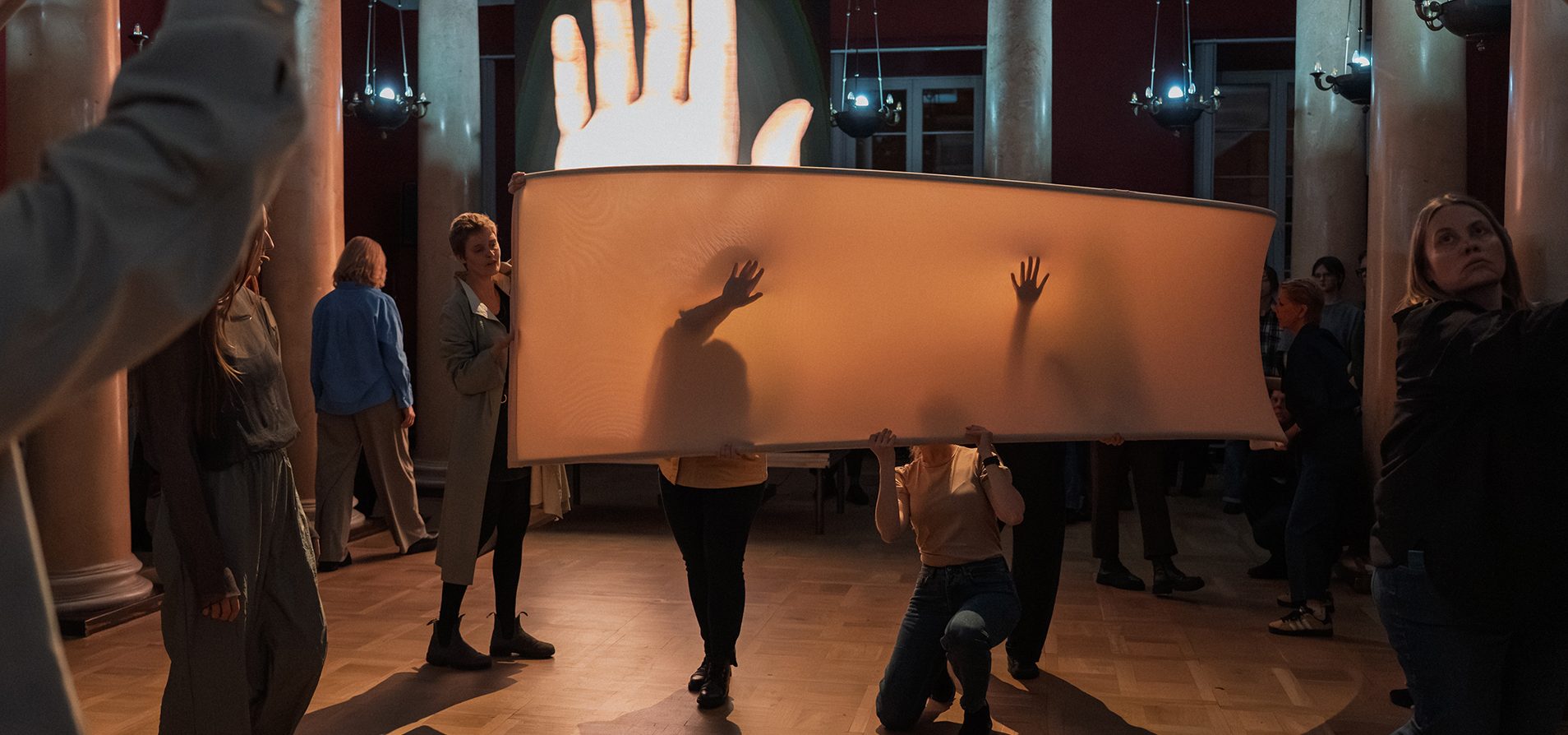
The work is inspired by the principles of classical Greek drama, adapted to contemporary reality: here, the inner transformations of the protagonist are accompanied by the voices of the chorus. Classical Greek tragedy, presently taking place behind the doors of a psychotherapist’s office or on phone screens, allows us to look at the altered relationship between the individual and the community. Is virtual care really a sustainable salvation from emotional chaos, or should we look for other ways to create connections with ourselves, others, and the world? Spores is the debut performative work by visual art duo Pakui Hardware, created in collaboration with a large team of performing artists. Contemporary electronic music, polyphonic sound structures performed live by a community choir, video-sculptural scenography, and movement scheme – all of this becomes a new, performative, pulsating body that has grown out of separate spores.
The relationship between today’s technologies and bodies and their health has been the subject of our research since the founding of Pakui Hardware. We are interested in how technological progress is changing our bodies and how every cell is being harnessed for economic productivity, while at the same time it seemingly makes our daily tasks and communication easier. Recently, we have often noticed that technology has engaged in transforming not only our physical bodies, but also our emotional health. This sensitive, intimate part of us suddenly becomes open to technological scrutiny, and we are willingly surrendering to it. This gave us the idea to create a musical performance that would entwine the classical tragedy genre with today’s technologised way of life. We wanted to rethink the structure of tragedy itself, where the protagonist converses with otherworldly beings, only they are not on Mount Olympus, but on a phone screen, while the chorus, as the voice of society, now expresses itself in the comments section. Delving into psychotherapy provided by artificial intelligence, we realised that its limitations are not only technical but also cultural, i.e. solely based on Western theories of therapy, which do not always take into account the cultural characteristics of each user, and a certain cosmology that they bring with them, characteristic of the country from which they originate. We wanted to question not only the AI therapy itself, but also the prevalence of established forms of therapy imported from the West: are there other, non-verbal ways to build a relationship with oneself, one’s past, and surrounding people – whether they be people or non-human beings?
– Pakui Hardware
While writing music for “Spores”, I sought to create a soundscape that would organically blend natural and synthetic sounds, combining live choral sounds, the soloist’s voice, and electronic music. I sought to reflect Pakui Hardware’s vision in the music, their research on the body, materiality, and the technological connections, while contrasting it with the charisma of the community choir and the DIY spirit. This is a new experience for me, requiring not only technical and musical solutions, but also sensitivity to the ensemble, space, and themes.
– Composer Miša Skalskis
Critical response
An EVENT-EXPERIENCE (!) was born, which can already be safely called one of the most memorable works created on the Lithuanian stage in recent years.
Ugnė Kačkauskaitė, menufaktura.lt
The choral sections, especially, carry an unexpected emotional density: their multi-voiced swell conjures a communal body, like networks of spores, a counterforce to the protagonist’s isolation, and a reminder that a healthy of state of mind is never only private, but is achieved in foraging of entangled communion. In these passages, the work reaches a moving resonance.
Qingyuan Deng, Cultbytes.com
The performance will ensue the vein of an operatic therapy, which draws influence from classical Greek drama made contemporary to the age of AI and musical theater.
Yonatan Eshban-Laderman, Impulsemagazine.com
The charismatic performer, Justina Mykolaitytė, a virtuoso vocalist, and co-author of the song score, could have carried the entire show. <…> . Soon the audience becomes an integral part of the performance. It is difficult to describe the thrill of an anonymous person standing next to you in a crowd who suddenly bursts into song.
David Ebony, Artworld.snapeditions.com
Credits:
Authors, stage directors and set designers: Pakui Hardware (Neringa Černiauskaitė and Ugnius Gelguda)
Text authors: Pakui Hardware and artificial intelligence therapist
Composer: Miša Skalskis
Vocal practices curator: Vaidas Bartušas
Co-author of solo vocal parts: Justina Mykolaitytė
Choreographer: Andrius Katinas
Costume designer: Morta Nakaitė
Video artist: Vaclovas Nevčesauskas
Lighting designer: Julius Kuršys
Sound engineer: Ignas Juzokas
Architect: Sigita Simona Paplauskaitė
Dramaturgy consultant: Gediminas Rimeika
Performers: Justina Mykolaitytė (protagonist), Anna Krasuckytė (organ), Spores choir – Smiltė Bagdžiūnė, Aistė Baltraitytė, Dalia Baltrušaitienė, Alexandra Bondarev, Akvilė Brazauskaitė, Vitalija Fokienė, Greta Germanavičiūtė, Laima Gric, Viktorija Jakštienė, Akvilė Jančauskaitė, Vytautas Juzėnas, Vėjūna Kaktavičienė, Urtė Karalaitė, Emilija Klimašauskaitė, Danutė Kryžanauskienė, Marija Lenkaitė, Kristina Mickevičienė, Karilė Mozerytė, Eglė Nešukaitytė, Daiva Petelienė, Nunilo Rumbutis, Aušrinė Rinkevičiūtė, Gabija Rostovskytė, Justė Savickienė, Justina Šimonytė, Raminta Šumskytė Sum, Dovilė Verikienė, Remigija Vilniūtė, Agnė Zeziulevičiūtė, Inna Zvinkli, Rugilė Žukaitė
Producers & co-commissioners: Operomanija, Performa
Premiere: 23 October 2025
Partners: Contemporary Art Centre, Lithuanian Culture Institute, Iškrovos
Supported by: Lithuanian Council for Culture, Vilnius City Municipality


